AI infrastructure / NEWS ANALYSIS
AWS launches GPU-aware routing for AI inference
AWS introduced GPU-aware routing for SageMaker HyperPod. Learn when intelligent request placement can improve production AI latency and utilization.
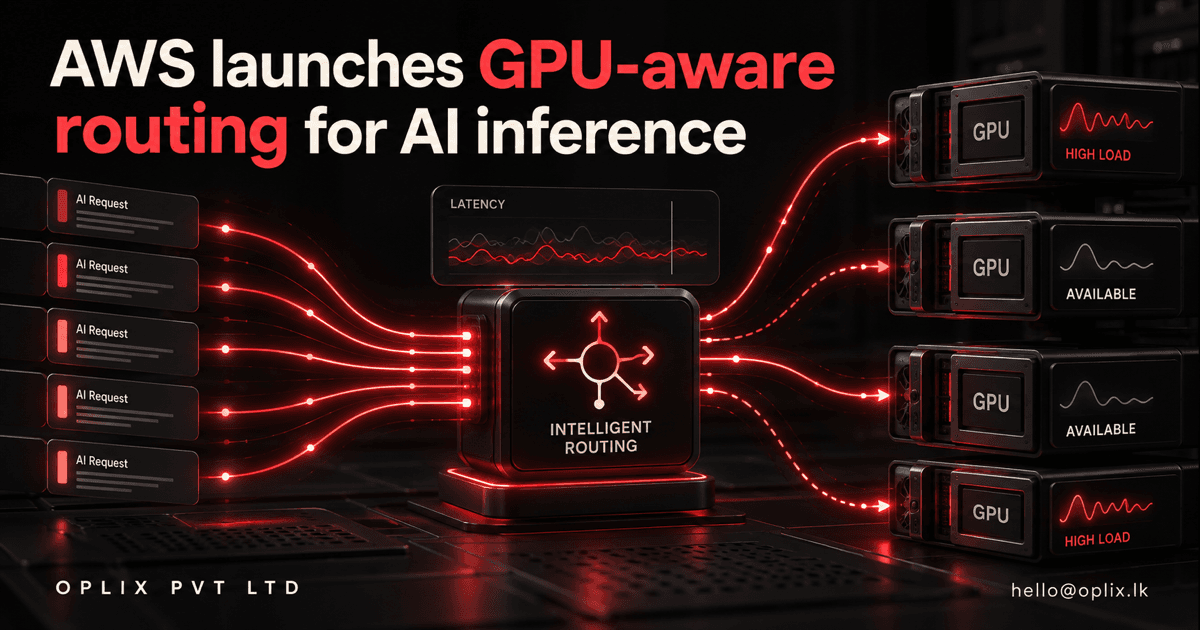
AWS introduced Amazon SageMaker HyperPod Inference Gateway on September 18, 2026. The Kubernetes-native add-on uses live GPU and request signals to route AI inference traffic toward an appropriate model-serving pod instead of relying only on round-robin or least-connections balancing.
For teams operating large models on shared GPU clusters, the announcement addresses a specific production problem: two healthy pods can have very different queue depth, cache state, adapter availability and remaining GPU capacity. Routing without that context can leave one replica overloaded while another is underused.
What did AWS announce?
SageMaker HyperPod Inference Gateway installs as an Amazon EKS managed add-on on existing HyperPod infrastructure. AWS says it works with OpenAI-compatible model servers and does not require changes to model servers or client applications.
The available per-cluster gateway has three main parts:
- Envoy Gateway terminates incoming traffic and exposes a private cluster endpoint.
- Body-Based Router reads the model field in an OpenAI-compatible request and directs it to the correct model pool.
- Endpoint Picker scores available pods using current metrics before choosing a backend.
The Endpoint Picker can consider KV-cache utilization, queue depth, active requests, prompt-prefix cache likelihood and whether a requested LoRA adapter is already loaded. Teams can adjust the weighting of those signals for latency-sensitive or throughput-oriented workloads.
What performance did AWS report?
AWS benchmarked the gateway against Kubernetes round-robin routing on the same model replicas. Its tests covered models from 8 billion to 235 billion parameters on H100 and A10G infrastructure, using mixed GPU fleets, bursty traffic and shared prompt prefixes.
The reported result depends heavily on workload conditions. AWS measured large reductions in time to first token in several mixed-hardware and burst scenarios, while a uniform fleet under steady traffic performed comparably to round-robin. The company summarizes the launch as reducing first-token latency by up to 82%, but that headline should not be treated as a guaranteed improvement for every application.
The useful conclusion is narrower: context-aware placement is most likely to help when replicas are not equally loaded, hardware differs, demand arrives in bursts, or requests can reuse cached prefixes and adapters. A team should benchmark its own traffic distribution, model mix and concurrency before estimating infrastructure savings.
Which production AI systems could benefit?
This capability is aimed at organizations already running model inference across Kubernetes GPU clusters. Potential fits include:
- Customer-facing AI assistants: Bursty chat traffic can create uneven queues and noticeable response delays.
- Document and knowledge systems: Requests may share long prompt prefixes that can benefit from cache-aware placement.
- Multi-model platforms: One gateway can route different model names to separate pools without duplicating that routing logic in every application.
- Fine-tuned model services: LoRA-aware routing can prefer a pod where the requested adapter is already resident.
- Mixed GPU fleets: Live capacity signals can help avoid sending new work to a smaller or saturated replica.
Smaller workloads running on a single endpoint, serverless API or uniform cluster may not gain enough to justify another infrastructure component. The decision should start with observed bottlenecks, not the existence of a new service.
What should teams evaluate before adopting it?
An inference gateway sits directly in the request path, so the rollout needs production-level engineering:
- Baseline first: Capture current time-to-first-token, end-to-end latency, throughput, error rate, queue depth and GPU utilization.
- Test realistic traffic: Include bursts, long contexts, different output lengths and the actual mix of models or adapters.
- Validate overload behaviour: AWS documents HTTP 429 responses with a
Retry-Afterheader when a pool is exhausted; clients still need bounded retries and a clear user experience. - Monitor the gateway itself: Route decisions, tail latency and failures should be visible alongside model-server and application telemetry.
- Plan rollback: Treat the add-on and its routing configuration as versioned infrastructure with a tested return path.
- Review regional support: AWS says the per-cluster gateway is available where the HyperPod inference add-on is available. Confirm the exact region and account before planning a migration.
AWS describes a second, global routing tier for cross-cluster and cross-region coordination as coming soon. Teams should not design current production availability around that unreleased tier.
Does GPU-aware routing automatically reduce AI costs?
Not automatically. Better placement can improve utilization and may reduce the spare capacity needed to absorb uneven load, but actual cost depends on cluster size, instance commitments, scaling behaviour, traffic patterns and operational overhead.
A responsible business case compares the existing system with the gateway under the same workload. It should include compute cost, engineering time, reliability targets and the value of faster responses. If the uniform-load baseline already performs well, the benchmark may show little reason to change.
Oplix perspective
SageMaker HyperPod Inference Gateway illustrates an important production AI principle: model quality is only one part of the user experience. Routing, caching, capacity, observability and recovery determine whether an AI feature remains responsive when real traffic arrives.
Oplix helps businesses design and build focused AI applications, the custom software around them and the automation that connects them to approved data and workflows. For a production AI project, that means starting with the business task and service target, measuring the current bottleneck, and selecting infrastructure only when it solves a demonstrated requirement.
Primary sources
TURN THE UPDATE INTO A USEFUL SYSTEM
How Oplix can help
Explore the services directly related to this development.
AI Development
Custom AI agents, assistants and product features connected to your data, tools and business workflows.
Explore AI Development →AI Automation
Connect business tools, process information, qualify leads, trigger actions, and draft communications—with people in control when judgment matters.
Explore AI Automation →Software Development
Custom dashboards, portals, mobile apps, internal tools, APIs, and SaaS products shaped around how your business actually operates.
Explore Software Development →