Voice AI / NEWS ANALYSIS
Gemini 3.8 Live brings real-time voice agents closer to production
Google's Gemini 3.8 Live models add real-time voice, visual context and background tool use. Here is what businesses should evaluate before building.
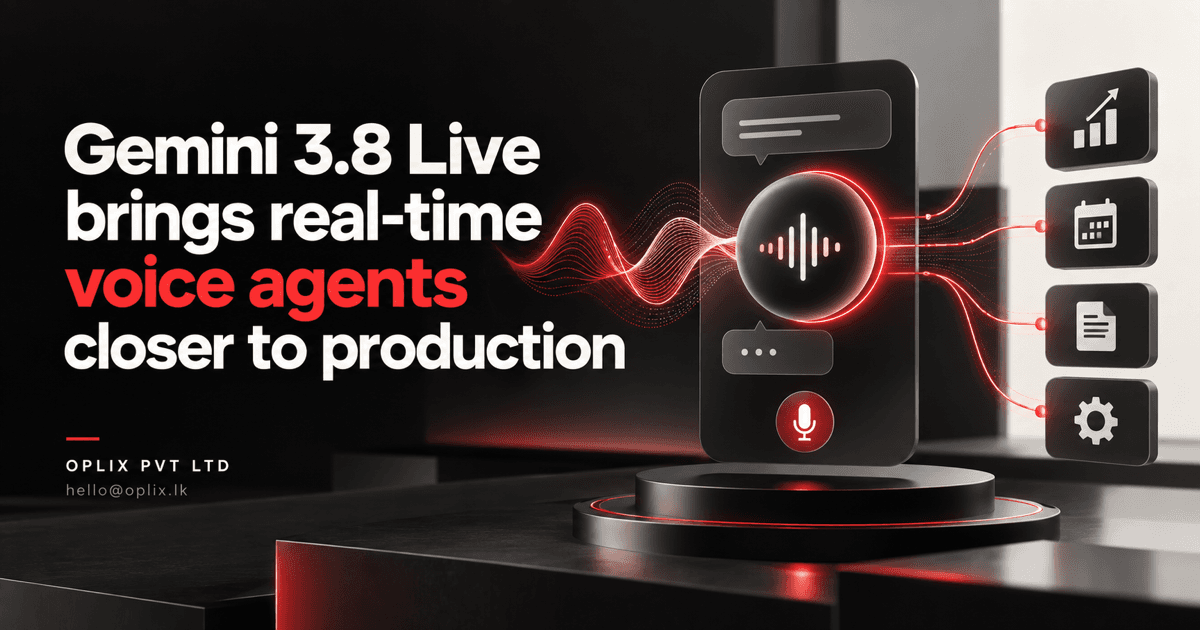
Google released Gemini 3.8 Live and Gemini 3.8 Live Extended Thinking on September 15, 2026. The models are designed for real-time spoken interaction, with visual context, tool use and longer reasoning available while a conversation continues. For businesses, the practical opportunity is a voice interface that can do more than answer questions—but it still needs a carefully bounded workflow behind it.
What did Google announce?
Gemini 3.8 Live is positioned for fast, fluid conversations at scale. Google says it can process visual input in near real time, switch automatically across 97 supported languages and execute tools or API calls in the background without stopping the conversation.
Gemini 3.8 Live Extended Thinking is intended for more complex, multi-step tasks. It can acknowledge a request, continue speaking and provide progress updates while reasoning or background actions continue.
Both models began rolling out through the Gemini API and Google AI Studio. Google also described separate availability paths for consumer and enterprise products, some of which remain private preview or “coming soon.” Availability should therefore be verified for the exact product and account before a team plans a launch.
Why does background tool use matter?
Traditional voice assistants often follow a rigid turn: listen, stop, process and respond. A model that can keep a natural conversation going while approved tools work in the background creates a different experience.
A customer could describe a problem while the assistant retrieves an order. An employee could continue explaining an equipment issue while the system checks documentation. A field worker could ask a question while the application gathers information from several internal services.
The important word is approved. A fluent conversation should not give a model unlimited access. Every tool needs a defined purpose, narrow permissions, validated inputs and a clear rule for actions that require human confirmation.
What can businesses build with Gemini 3.8 Live?
The strongest use cases combine voice with an existing operational system:
- Guided customer service: Collect context conversationally, retrieve account information and prepare a resolution for an employee or customer to confirm.
- Field-service assistance: Use spoken questions and visual context to help a technician locate procedures, capture observations and prepare structured notes.
- Accessible internal workflows: Let employees navigate knowledge, forms or routine tasks using speech while preserving the same permissions as the underlying software.
- Multilingual intake: Support fluid language changes during an initial conversation, followed by validation before information enters a business system.
These are product patterns, not automatic outcomes. Audio quality, latency, accents, background noise, interruption handling and unreliable connectivity all affect the real experience.
How can developers access the models?
In addition to Google's Gemini API and AI Studio, Vercel announced that both models are available through its AI Gateway. Vercel's integration uses its AI SDK real-time API and WebSocket connections. It identifies the standard model as google/gemini-3.8-live and the extended-thinking model as google/gemini-3.8-live-extended-thinking.
Vercel says its gateway can also centralize usage and cost tracking, retries, failover and performance configuration. Those platform features can simplify implementation, but teams should still evaluate provider terms, regional availability, data handling, observability and fallback behaviour for their own requirements.
What should a production voice agent include?
A useful prototype can be built quickly; a dependable voice product requires more deliberate engineering:
- A bounded job: Define what the agent can answer, which systems it can access and where it must stop.
- Explicit confirmation: Require approval before bookings, messages, purchases, record changes or other consequential actions.
- Visible state: Tell the user when the system is listening, processing, calling a tool or waiting for confirmation.
- Recovery paths: Let people correct transcripts, repeat information, switch to text or reach a human.
- Evaluation: Test task completion, tool accuracy, latency, interruption handling and failure recovery—not only how natural the voice sounds.
- Privacy controls: Minimize captured audio and personal data, apply appropriate retention rules and make recording behaviour clear.
Oplix perspective
Gemini 3.8 Live makes voice a more capable application interface, but the model is only one layer. The durable business value comes from connecting conversation to the right data, software and approval process.
Oplix helps teams design and build focused AI assistants, workflow automation and custom software around a measurable operational task. A sensible first pilot uses one audience, one workflow and a limited set of tools, with human review wherever judgment or consequence is involved.
Primary sources
TURN THE UPDATE INTO A USEFUL SYSTEM
How Oplix can help
Explore the services directly related to this development.
AI Development
Custom AI agents, assistants and product features connected to your data, tools and business workflows.
Explore AI Development →AI Automation
Connect business tools, process information, qualify leads, trigger actions, and draft communications—with people in control when judgment matters.
Explore AI Automation →Software Development
Custom dashboards, portals, mobile apps, internal tools, APIs, and SaaS products shaped around how your business actually operates.
Explore Software Development →