AI models / NEWS ANALYSIS
GPT-6 Astra arrives: capabilities, pricing and practical business use cases
OpenAI has introduced GPT-6 Astra for advanced computer use and professional work. We examine its pricing, access, risks and practical business fit.
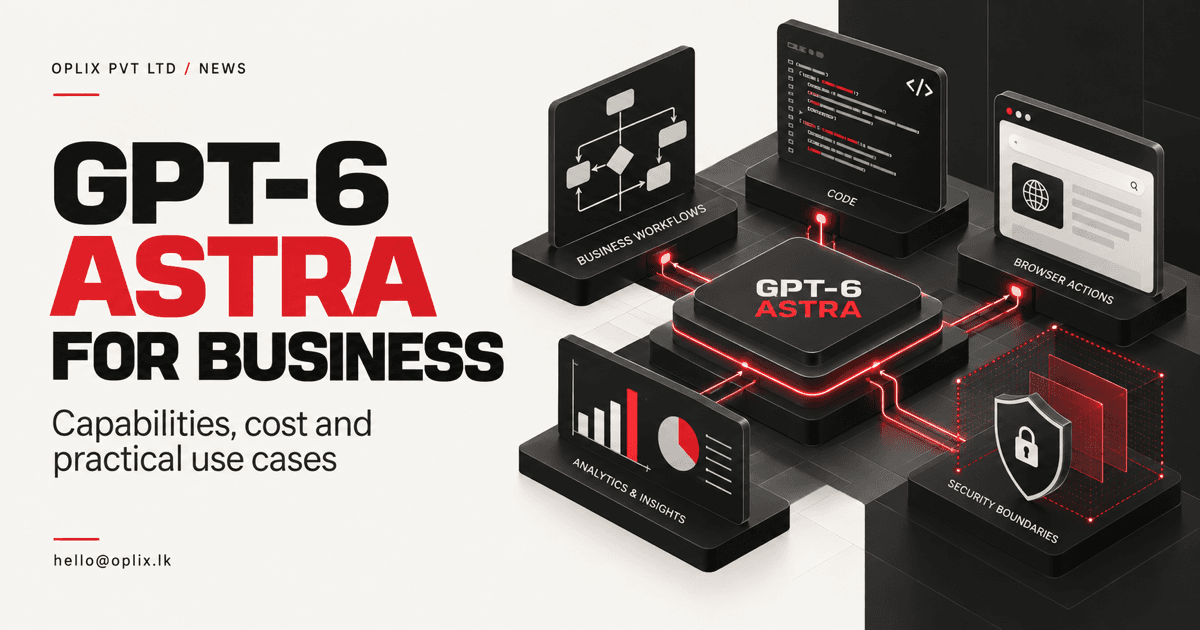
OpenAI introduced GPT-6 Astra in September 2026 as a model for complex computer use, software engineering, cybersecurity, science and professional work. For a business, the important question is not whether the model tops a benchmark. It is whether Astra can improve a specific workflow enough to justify its cost, controls and review burden.
What did OpenAI announce?
OpenAI announced a research launch on September 3 followed by broader availability on September 9. The company says GPT-6 Astra can browse, use computers, work on software and handle demanding analytical tasks. It is rolling out across eligible ChatGPT plans and through API and cloud channels.
The API model is listed as gpt-6-astra, with pricing of $10 per million input tokens and $50 per million output tokens at announcement. Those prices make workload design important: long contexts, repeated tool calls and verbose outputs can materially change the cost of a production system.
OpenAI reports stronger computer-use performance and lower task time than GPT-5.6 Sol. Those are vendor-reported comparisons, not a guarantee for a particular company or workflow. A useful evaluation must use the documents, applications, exceptions and quality standards found in the real process.
Where could GPT-6 Astra help a business?
The most credible opportunities are bounded tasks that combine reasoning with tools:
- Software delivery: investigating an issue, preparing a reviewed code change or assembling release evidence.
- Operational research: collecting information from approved sources and producing a traceable decision brief.
- Document-heavy work: comparing requirements, extracting exceptions and preparing a structured review packet.
- Computer workflows: navigating approved interfaces to complete repeatable steps with human confirmation before consequential actions.
These are stronger starting points than a broad instruction such as “run our operations.” A narrow task provides a known input, a clear definition of done and an observable failure path.
What will GPT-6 Astra cost in practice?
Token prices are only one part of total cost. A production workflow may also need sandboxed execution, storage, observability, human review, retries and integration maintenance. A model that finishes a job faster may be economical even at a higher token rate; a poorly scoped workflow may become expensive regardless of the model.
A pilot should therefore track cost per accepted outcome, not cost per API call. Measure how often the work passes review, how much correction it needs and whether it reduces the total time spent by the team.
What risks need to be designed around?
OpenAI classifies the model at its Critical cybersecurity capability threshold. That makes access control and monitoring central considerations, especially when the model can reach code, infrastructure or credentials.
Use least-privilege credentials, isolate execution, log tool activity and require explicit approval for publishing, sending, purchasing, deleting or changing production data. Sensitive workflows should also have a defined stop condition and a person who owns exceptions.
A sensible adoption plan
Choose one workflow with enough volume to measure but limited consequences if it fails. Build a representative test set, compare Astra with a less expensive model, and record quality, latency, review time and total cost. Move into production only when the evidence shows a repeatable advantage.
Oplix perspective
GPT-6 Astra is most useful as one component in a designed operating system. Oplix can help identify the right use case, build the integrations and approval gates, and test the result against real business outcomes. The model may change quickly; a well-structured workflow can remain understandable and replaceable.
Primary sources
TURN THE UPDATE INTO A USEFUL SYSTEM
How Oplix can help
Explore the services directly related to this development.
AI Development
Custom AI agents, assistants and product features connected to your data, tools and business workflows.
Explore AI Development →AI Automation
Connect business tools, process information, qualify leads, trigger actions, and draft communications—with people in control when judgment matters.
Explore AI Automation →Software Development
Custom dashboards, portals, mobile apps, internal tools, APIs, and SaaS products shaped around how your business actually operates.
Explore Software Development →