AI agents / NEWS ANALYSIS
OpenAI introduces the Agents API: what it means for business automation
OpenAI has launched a managed API for long-running cloud agents. Here is what businesses should evaluate before connecting agents to real workflows.
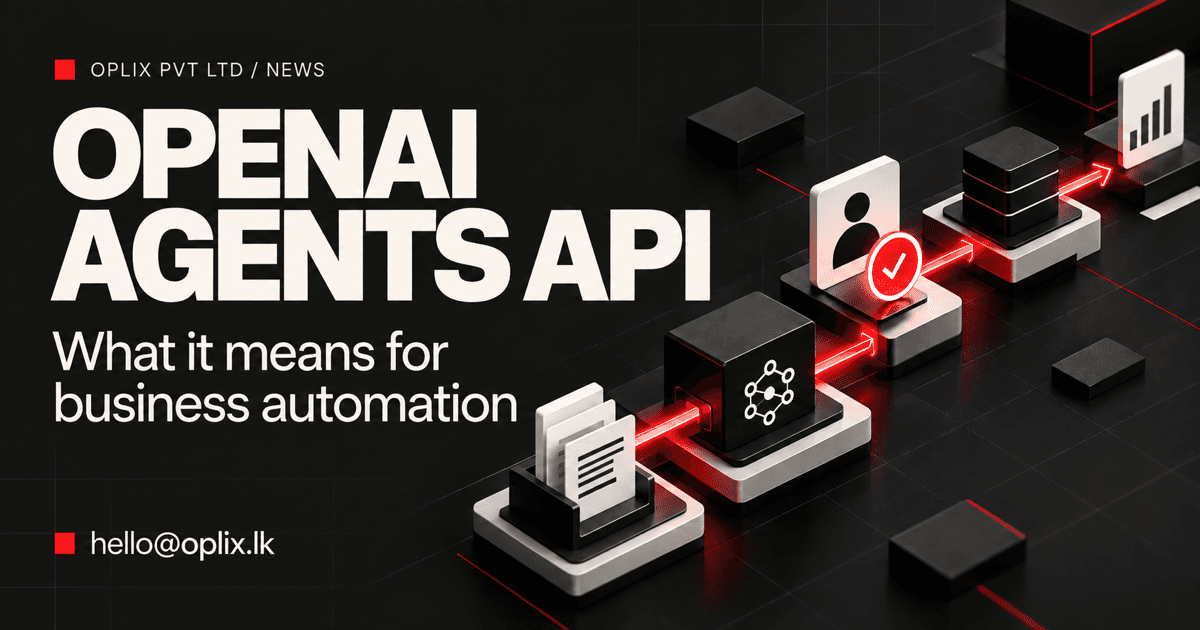
OpenAI introduced its Agents API in public beta on September 10, 2026. The service provides a managed harness for long-running cloud agents while allowing developers to choose where those agents execute their work.
What was announced?
According to OpenAI, the API manages the agent loop, context, tool use and long-running sessions. Developers specify the task, model, tools and execution environment. That environment may be OpenAI-hosted, self-hosted or provided by an infrastructure partner.
Vercel also announced an integration that combines the Agents API with Vercel Sandbox, Queues, Functions and signed webhooks. Its implementation isolates each session and preserves a workspace across follow-up instructions.
The practical shift: Teams can spend less time assembling orchestration infrastructure—but they still own the workflow, access controls, evaluation and business outcome.
Why this matters for businesses
The announcement makes more ambitious workflows technically approachable. An agent could collect information, work across files, call approved tools and continue a multi-step task without requiring one continuous browser or server process.
That does not make every process ready for autonomous execution. A useful production system still needs narrow permissions, explicit approval points, recovery paths, audit records and a clear owner when the agent is uncertain.
Three questions to answer before adopting it
- What is the bounded job? Begin with one repeatable outcome instead of asking an agent to “run the business.”
- Which actions require approval? Sending messages, changing customer records, spending money and publishing content should have deliberate controls.
- How will success be measured? Track completion quality, exceptions, review time, cost and recovery—not only whether the agent returned an answer.
Oplix perspective
The strongest opportunity is not a generic chatbot. It is a focused operational agent connected to a well-defined workflow: preparing an inquiry for review, organizing documents, updating an internal system or assembling a research packet with traceable sources.
For most teams, the sensible first step is a contained pilot with one owner, one measurable result and human review before consequential actions. The platform can evolve; the operating rules must be designed intentionally.
Primary sources
TURN THE UPDATE INTO A USEFUL SYSTEM
How Oplix can help
Explore the services directly related to this development.
AI Development
Custom AI agents, assistants and product features connected to your data, tools and business workflows.
Explore AI Development →AI Automation
Connect business tools, process information, qualify leads, trigger actions, and draft communications—with people in control when judgment matters.
Explore AI Automation →Software Development
Custom dashboards, portals, mobile apps, internal tools, APIs, and SaaS products shaped around how your business actually operates.
Explore Software Development →