Legal technology / NEWS ANALYSIS
OpenAI launches Astra for Law for legal AI workflows
OpenAI's Astra for Law combines legal search, GPT-6 Astra and governed workflows. Learn what it offers, who can access it and why lawyer review still matters.
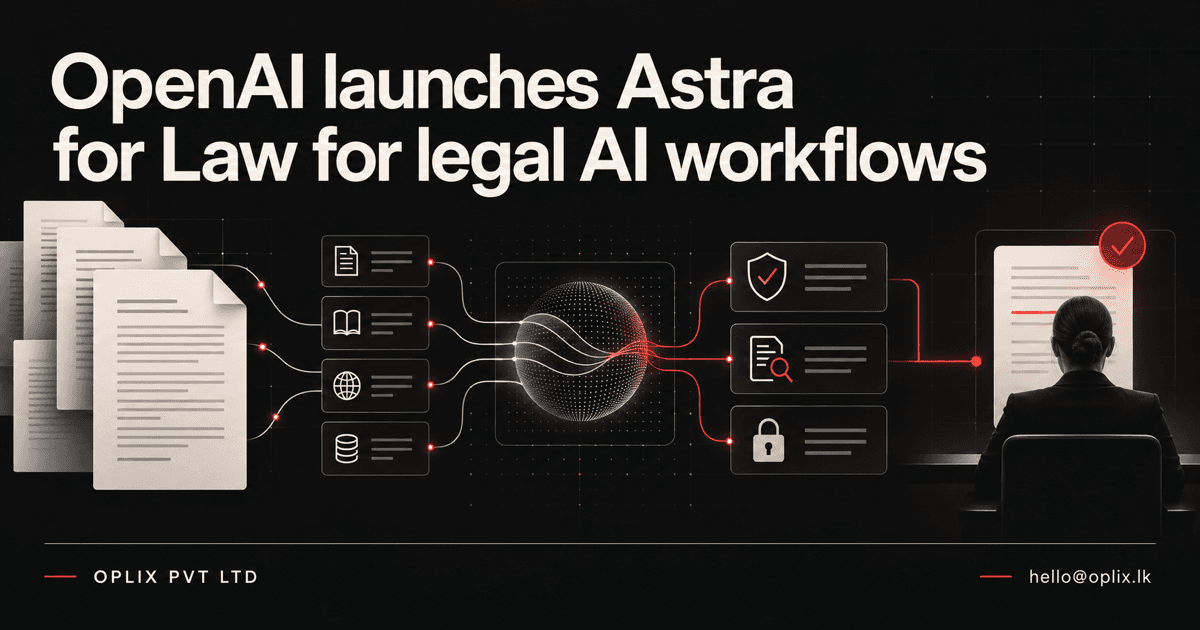
OpenAI introduced Astra for Law on September 17, 2026 as a legal-work configuration of GPT-6 Astra. It combines the model with a dedicated legal search index, instructions for legal analysis and writing, enterprise controls, and an ecosystem of plugins that can connect legal teams to the tools and knowledge they already use.
The launch is aimed at law firms and legal technology companies, not consumers seeking automated legal advice. OpenAI says the initial release is limited to selected United States law firms through Trusted Access in ChatGPT and Codex, with API availability coming later. Its own Help Center instructs users to review answers and cited sources before relying on them.
What is OpenAI Astra for Law?
Astra for Law is GPT-6 Astra configured for professional legal research and workflows. OpenAI describes four connected parts:
- GPT-6 Astra provides the underlying model capability.
- A legal search index covers United States case law, statutes, regulations, court rules and administrative decisions.
- Legal instructions guide analysis and writing around authorities, client facts, arguments, deal terms, objections and uncertainty.
- Firm controls and integrations let eligible organizations define permitted sources, permissions, review processes and connections to specialist systems.
OpenAI says the legal index spans more than 230 million URLs and adds sources daily. The company’s work with Free Law Project brings CourtListener’s case-law collection into the research experience. That index is intended to help the system find relevant authorities and passages, while complementing licensed legal research products rather than replacing them.
What can Astra for Law help lawyers do?
The stated use cases begin with research. A lawyer can provide client facts and ask the system to find relevant authorities, locate supporting passages, compare factual patterns and identify decisions that weaken an argument.
Custom instructions then support work that follows the search: applying authorities to the facts, developing an argument, comparing deal terms, identifying uncertainty and explaining how a contractual exception might change risk allocation.
OpenAI also describes firm-specific applications built with selected law firms:
- An agreement analyzer that uses negotiation playbooks and selected precedents to identify risks across connected provisions.
- A due-diligence workflow that traces findings back to data-room sources and surfaces questions that may affect a transaction.
- A capital-markets workflow that assists with IPO drafting and carries deal changes across a filing for lawyer review.
These examples show a broader product pattern: the model is most useful when it is connected to approved knowledge, embedded in a defined process and surrounded by professional review.
How did OpenAI evaluate legal research performance?
OpenAI tested the complete Astra for Law configuration on 200 United States legal-research questions from a private validation set of Vals AI’s Legal Research Bench.
At the highest reasoning setting, OpenAI reports that Astra for Law passed the benchmark’s overall correctness check on 54.0% of questions, compared with 38.7% for GPT-6 Astra using web search alone. The company describes that difference as a 40% relative improvement. It also reports finding 24% more reference cases on case-law questions and retrieving up to 54% more relevant passages from the correct opinions on an audited target set.
Those are vendor-published results on a particular US legal benchmark. They should not be interpreted as a guaranteed accuracy rate for a firm, jurisdiction, practice area or matter. The reported 54.0% correctness figure also makes the need for source review unmistakable: a stronger research system can still produce incomplete or incorrect work.
A responsible buyer should evaluate the product on representative internal tasks, compare it with the current research process and measure citation accuracy, authority relevance, issue coverage, time saved and the volume of corrections required.
Who can access Astra for Law?
OpenAI says Astra for Law will initially be offered to selected law firms in the United States through a Trusted Access Program. Access is intended for eligible lawyers and people working under their supervision.
The model will appear as GPT-6 Astra Law in the model picker. OpenAI says API access is coming soon under gpt-6-astra-law, so teams should not treat that future API identifier as generally available until their account and current documentation confirm access.
Organizations interested in early access must contact their OpenAI account team or OpenAI Sales. The announcement does not provide public self-service pricing for Astra for Law.
What privacy and governance controls matter?
Legal workflows may contain confidential client information, privileged communications, commercially sensitive documents and restrictions on who may view a matter. Model quality alone is therefore insufficient.
OpenAI says eligible firms can receive Zero Data Retention on the API and that ChatGPT Enterprise usage is excluded from human review by default. It also says it is working on information permissions, ethical walls, client instructions and firm oversight.
Before using any AI system with client material, a firm still needs to verify the exact terms and controls applying to its workspace and workflow. A practical review should cover:
- which documents and systems the tool can access;
- whether access follows matter-level permissions and ethical walls;
- where prompts, retrieved sources, outputs and audit records are processed and retained;
- whether client instructions or professional obligations restrict AI use;
- who reviews output before it informs advice, drafting, filing or negotiation;
- how incorrect citations, missing authorities and security incidents are escalated.
Privacy labels should not replace a documented data-flow review. Controls must be tested in the actual configuration, including every plugin, connector and downstream system.
What are the new legal plugins and skills?
OpenAI announced 26 partner-built plugins covering legal practice and business operations. The examples include connections involving iManage, Intapp and DeepJudge, while Thomson Reuters is bringing HighQ matter context into ChatGPT and previewing a CoCounsel Legal connector.
The launch also includes nine community plugins and 47 custom skills from lawyers and legal engineers. OpenAI says firms can adapt those skills to their own work.
Availability and access requirements can differ by plugin. Each integration also expands the system’s data and permission boundary. Legal teams should assess a plugin’s vendor, data access, authentication, matter permissions, retention, logging and failure behaviour before enabling it.
ChatGPT for Word is also generally available. OpenAI positions it for proofreading, suggested edits and formatting checks inside a familiar drafting tool. As with research output, the lawyer remains responsible for the document and its consequences.
Does Astra for Law replace lawyers or legal research platforms?
No. OpenAI presents Astra for Law as infrastructure for lawyers, firms and legal technology companies to build around their expertise. The announcement repeatedly centers professional judgment, source examination, permissions and firm-defined review processes.
The legal search index is also described as complementing licensed content and specialist products. Coverage of a large corpus does not guarantee that every relevant authority, commentary, filing, local rule or licensed source is present. Jurisdiction, date, precedential weight and subsequent history still need professional verification.
For businesses outside a law firm, Astra for Law should not become a shortcut for generating unreviewed legal advice. Legal questions affecting rights, obligations, disputes or regulatory exposure belong with qualified counsel.
What should a responsible legal AI pilot include?
A pilot should start with a bounded, reversible workflow where lawyers can compare the AI-assisted result with an established process. Research summaries, document organization or first-pass issue spotting may be easier to evaluate than autonomous recommendations or external filings.
The implementation should include:
- an approved source and data-access policy;
- matter-level permissions and tested isolation;
- a representative evaluation set with known authorities and difficult edge cases;
- citation and quotation verification against original sources;
- mandatory professional review before consequential use;
- clear logging, correction and incident procedures;
- a fallback when the model, search index or integration is unavailable;
- periodic reassessment as models, sources and plugins change.
The success measure should be better-supported work with an auditable review path—not simply more AI output.
Oplix perspective
Astra for Law reinforces a principle that applies across high-trust industries: an AI model becomes operationally useful only when it is connected to the right sources, constrained by permissions, evaluated on real work and placed inside a human-owned decision process.
Oplix helps businesses design and build governed AI systems, workflow automation and custom software around approved information and explicit review points. For legal-sector projects, that technical work must be directed by the organization’s qualified legal, privacy and security professionals.
Oplix is not a law firm and does not provide legal advice. We can help implement the software, integrations, permissions, monitoring and approval workflow; the legal standards, professional judgments and final work product remain with authorized legal professionals.
Primary sources
TURN THE UPDATE INTO A USEFUL SYSTEM
How Oplix can help
Explore the services directly related to this development.
AI Development
Custom AI agents, assistants and product features connected to your data, tools and business workflows.
Explore AI Development →AI Automation
Connect business tools, process information, qualify leads, trigger actions, and draft communications—with people in control when judgment matters.
Explore AI Automation →Software Development
Custom dashboards, portals, mobile apps, internal tools, APIs, and SaaS products shaped around how your business actually operates.
Explore Software Development →