AI for public safety / NEWS ANALYSIS
How SensoRy AI uses ChatGPT to turn wildfire sensor data into actionable alerts
OpenAI profiles SensoRy AI, a wildfire sensor network that uses ChatGPT to explain complex readings. Here is what the real-world system teaches businesses.
WATCH THE PRIMARY SOURCE
Detecting wildfires with ChatGPT
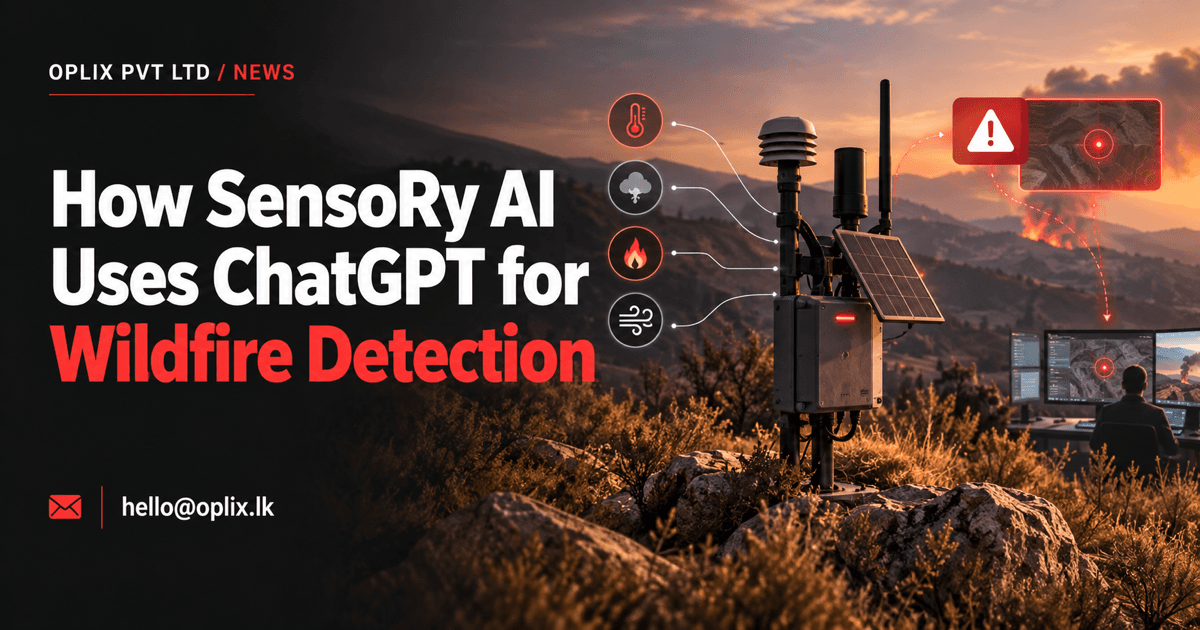
OpenAI’s September 14 video profiles SensoRy AI, a wildfire early-warning system founded by Ryan Honary. The system monitors terrain using physical sensors and applies AI to detect possible fire conditions. ChatGPT’s role, according to the video, is to help translate complex sensor readings into clear information that firefighters and residents can understand and act on. It is a useful example of AI supporting a real operational system—not replacing the sensors, domain experts or emergency response.
What does the SensoRy AI system do?
SensoRy AI began as Honary’s fifth-grade science project after he saw the destruction caused by California wildfires. The company says the project developed into a sensor network and wildfire risk-management platform designed for early detection.
OpenAI’s video description says the field sensors monitor heat, smoke, flame and plume activity in remote terrain. When the system identifies a potential fire, sensor data can be converted into a clearer alert for people responsible for responding.
That distinction matters. The physical network observes conditions in the environment. SensoRy AI’s own detection platform analyzes those signals. ChatGPT provides an interface and communication layer around the data described in the video.
How is ChatGPT used for wildfire detection?
The video shows two practical interaction patterns. Honary uses ChatGPT hands-free while working in the field, and he demonstrates a walkie-talkie interface that lets firefighters ask questions about a potential fire.
This is less about asking a general chatbot for an opinion and more about making specialized system information accessible. A conversational interface can explain readings, summarize what changed and present the result in language suited to a responder or resident.
The quality of that answer still depends on the underlying data, integration and operating rules. A language model cannot compensate for a failed sensor, missing coverage or an incorrect escalation policy. Emergency decisions must remain with trained authorities.
Is SensoRy AI operating outside a prototype?
Yes. The City of Laguna Beach announced on August 20, 2026 that it selected SensoRy AI’s wildfire risk-management sensor network for deployment. The city said sensors would monitor high-risk open space and selected inner canyons, provide rapid notifications to first responders and connect to a broader regional network around the wildland-urban interface.
SensoRy AI also reports a permanent deployment in Irvine Open Space Preserve following pilot work with local partners. These deployments do not prove that every alert will be correct or that the system can eliminate wildfire risk. They do show that the concept has moved beyond a classroom demonstration into evaluated field use.
What can businesses learn from this AI implementation?
Start with the real-world signal
Useful AI systems begin with dependable inputs. For SensoRy AI, those inputs come from environmental sensors. In a business, they might come from a CRM, support inbox, production system, inspection form or connected device.
Give AI a bounded responsibility
The language model has a specific role: helping people understand and interact with complex data. It does not need unrestricted control of the full operation to create value.
Design for the person who must act
Raw data is only useful when it reaches the right person in time and in a form they can interpret. The interface, alert language and escalation path are part of the product—not secondary details.
Validate outside the demonstration
A compelling prototype is the beginning. Field conditions, noisy signals, connectivity failures, false alerts and security requirements determine whether a system is dependable. SensoRy AI’s path from a hair-dryer experiment in a garage to monitored outdoor deployments illustrates the importance of iteration in the environment where the system will operate.
What safeguards would a system like this require?
Public-safety technology needs layered controls. Sensor health should be observable, alerts should preserve the originating evidence, and operators should be able to see uncertainty rather than receiving false confidence. Communications need secure access and a fallback path when AI, connectivity or a device is unavailable.
The system should also make the division of responsibility explicit. AI can organize and explain information; trained responders decide how to assess and respond to a suspected fire.
Oplix perspective
The strongest AI products connect domain-specific data to a carefully designed human workflow. Oplix helps businesses apply the same systems thinking to less safety-critical operations: combining reliable inputs, custom software, AI assistance, automation and approval points around a measurable job.
The lesson from SensoRy AI is not that every company needs a chatbot. It is that AI becomes valuable when it has the right data, a narrow responsibility and a clear path from insight to human action.
Primary sources
TURN THE UPDATE INTO A USEFUL SYSTEM
How Oplix can help
Explore the services directly related to this development.
AI Development
Custom AI agents, assistants and product features connected to your data, tools and business workflows.
Explore AI Development →AI Automation
Connect business tools, process information, qualify leads, trigger actions, and draft communications—with people in control when judgment matters.
Explore AI Automation →Software Development
Custom dashboards, portals, mobile apps, internal tools, APIs, and SaaS products shaped around how your business actually operates.
Explore Software Development →