AI automation / NEWS ANALYSIS
TypeSafe AI launches Jev for typed automation decisions
TypeSafe AI's Jev returns typed decisions, probabilities and confidence instead of prose. Here is where it may fit—and what businesses should verify.
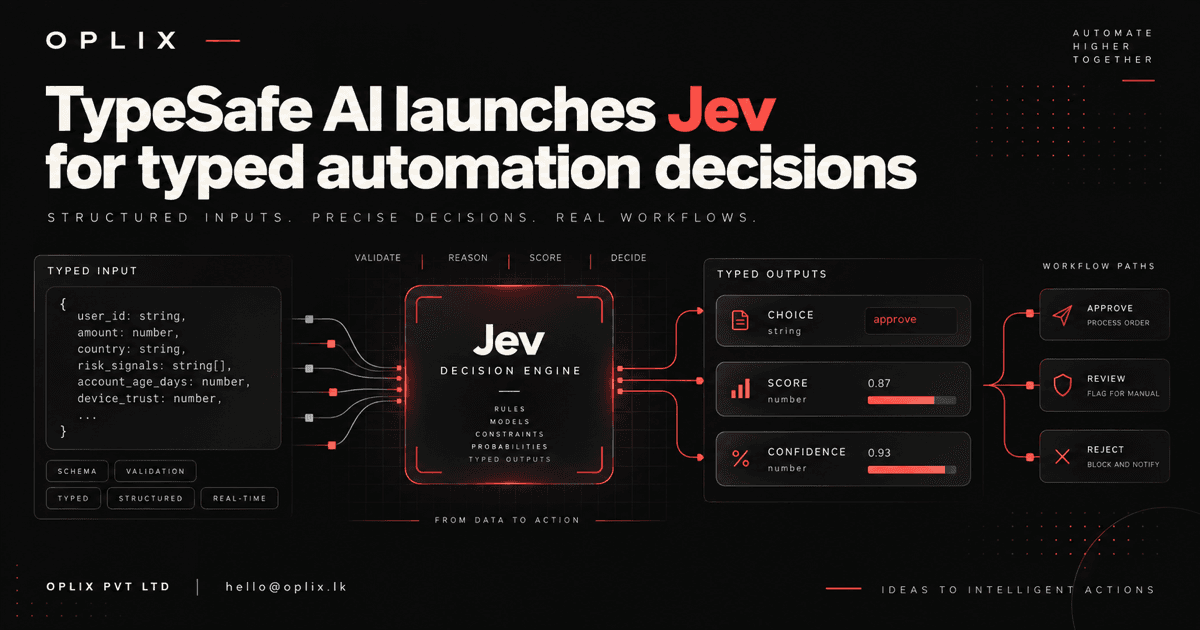
TypeSafe AI introduced Jev on September 15, 2026 as an early-access model for a narrow but important job: making structured decisions that software can use directly. Instead of generating a paragraph and asking an application to parse it, Jev accepts state plus predefined questions and returns typed values, probabilities and confidence.
That makes Jev potentially relevant to workflows that classify, route, score, extract or branch. It is not a replacement for every large language model, and it is not a reason to automate a decision without safeguards. The useful idea is that some business tasks need a bounded decision interface more than they need open-ended prose.
What did TypeSafe AI launch?
TypeSafe calls Jev its first public “System One Model.” The company says it built a new architecture, a parallel sampler and a training method called Reinforcement Learning for Calibrated Decisions, or RLCD.
The product’s input-output contract is the more practical distinction:
- An application supplies unstructured state, such as text or a compact description of a situation.
- The developer defines the possible output types in advance.
- Jev evaluates multiple questions and returns structured values, probability distributions and confidence.
- Application code decides what to do with those results.
TypeSafe describes this pattern as “unstructured state in, typed probabilistic decisions out.” Jev gives up free-form string generation in favour of outputs intended to fit directly into software logic.
How is Jev different from a chatbot or JSON mode?
A conventional language model generates tokens sequentially. It can write explanations, draft content, answer questions and produce code, including JSON when prompted or constrained by a schema. That flexibility is valuable, but a production application still has to validate the response and decide how to handle invalid, incomplete or unexpected output.
Jev is presented as a decision model rather than a writing model. Its output space is declared before the request, and its answers are designed to remain within that typed structure. TypeSafe says the model evaluates questions in parallel rather than producing a free-form response token by token.
This does not mean the model’s business judgment is automatically correct. A response can match a schema perfectly and still choose the wrong category, assign an unhelpful score or miss context in the input. Type safety controls the shape of an answer; evaluation and workflow design determine whether that answer is useful enough to act on.
What outputs can Jev return?
TypeSafe’s documentation describes three primitives:
- Choice selects from developer-defined options and returns the choice, its probabilities and confidence.
- Score selects a value on a defined numerical scale and returns the score, probabilities and confidence.
- Noul returns a continuous value between zero and one.
The documentation recommends atomic, well-scoped questions. A complex judgment should be decomposed into independent questions, with the surrounding code combining the results. This is a meaningful design constraint: Jev is positioned for fast decisions inside a workflow, not extended reasoning or long-form generation.
For example, a team could ask separate questions about an incoming request’s topic, urgency and completeness. Code could then route a high-confidence, complete request to the appropriate queue while sending an uncertain result to a person. The exact categories, thresholds and escalation rules would still need to come from the organization’s real operating policy.
Where could typed AI decisions help a business?
TypeSafe lists classification, routing, scoring, extraction and branching as target patterns. In a business system, those patterns may support:
- Lead and inquiry triage: identify a request type and route it to the right team when confidence clears an approved threshold.
- Support operations: classify a message, assess whether required information is present and flag uncertain cases for review.
- Document workflows: extract or score defined attributes before a human approves the next step.
- Quality control: evaluate a narrow condition and use the probability output as one signal in a larger rules-based check.
- AI guardrails: score or verify another model’s input or output before an application continues.
These are potential implementation patterns, not evidence that Jev is suitable for a particular regulated, high-stakes or customer-facing decision. Teams should test the model on representative examples, edge cases and deliberately ambiguous inputs before allowing any autonomous action.
How should teams interpret TypeSafe’s performance claims?
TypeSafe advertises Jev as up to 193.6 times faster and 444.6 times cheaper in its workflow evaluations. Its launch article also lists a $0.042 per million input-token price and response times from 70 to 500 milliseconds.
Those figures are vendor-published results, not independent guarantees. TypeSafe explicitly says the headline gains are likely at the high end of real-world improvements. The company also notes that its capabilities team created the evaluated workflows, that some bias may exist, and that comparison models used a wrapper designed to return probabilities and structured decisions—a setup that can increase their latency and cost.
The appropriate response is to benchmark the actual workload. A useful evaluation would compare accuracy, calibration, latency, cost and exception volume against the current process and at least one credible alternative. It should also include the engineering and review work needed around each model, not just the API price.
What about TypeSafe’s “zero hallucinations” claim?
TypeSafe uses “zero hallucinations” to describe Jev’s guaranteed adherence to predefined output schemas. Its launch article clarifies that the plotted zero percent is not an empirical accuracy result; it follows from the model being unable to emit a value outside the schema.
That is an important technical property, but the phrase can be misunderstood. A valid typed answer can still be substantively wrong. Confidence can help software decide when to escalate, but a threshold does not remove the need for domain-specific tests, monitoring and a safe exception path.
Businesses should separate three questions:
- Did the response match the required type?
- Was the decision accurate and well calibrated on relevant data?
- Is the workflow safe when the model is uncertain or wrong?
Only the first is addressed by schema guarantees alone.
What should a responsible Jev pilot include?
A focused pilot should begin with one reversible workflow and a measurable baseline. Define the allowed outputs, the cost of false positives and false negatives, and the cases that must always go to a person.
The team should then:
- build an evaluation set from representative and difficult examples;
- compare Jev with the current manual or automated process;
- test confidence thresholds rather than assuming a default cutoff;
- log inputs, outputs, decisions and human overrides with suitable privacy controls;
- provide a fallback when the API is unavailable or the result is uncertain;
- review performance for drift before expanding autonomy.
Because Jev is in early access, teams should also verify current availability, limits, data-handling terms, regional requirements and support before designing it into a production dependency.
Oplix perspective
Jev highlights a useful shift in AI product design: not every operational problem needs a conversational interface. When the job is to make a small, repeatable decision inside software, a typed model with explicit probabilities may be easier to govern than open-ended text generation.
Oplix helps businesses identify those bounded opportunities, design the surrounding workflow and build the custom software and automation needed to put them into practice. That includes defining schemas and thresholds, connecting approved systems, creating review paths and measuring the result before increasing autonomy.
The right first question is not whether to replace an existing model with Jev. It is whether a specific business bottleneck can be expressed as clear inputs, typed decisions and a safe action path.
Primary sources
TURN THE UPDATE INTO A USEFUL SYSTEM
How Oplix can help
Explore the services directly related to this development.
AI Development
Custom AI agents, assistants and product features connected to your data, tools and business workflows.
Explore AI Development →AI Automation
Connect business tools, process information, qualify leads, trigger actions, and draft communications—with people in control when judgment matters.
Explore AI Automation →Software Development
Custom dashboards, portals, mobile apps, internal tools, APIs, and SaaS products shaped around how your business actually operates.
Explore Software Development →